How to Search Sources in a Family Tree in Ancestry

Jump to:
A. by Name
B. by Location
C. by Engagement
D. by Family Member
Due east. by Keyword
F. by Gender and Race/Nationality
G. by Collection Focus
Refining Your Search Results
– H. Sliders
– I. Category Filters
Genealogy website Beginnings.com offers flexible searching of its massive databases—but if y'all don't how to dispense those options, they're useless to you. So let'due south alter our family history race route to include some additional training on the site's search form. In this article adapted from the new 2d edition of my volume, the Unofficial Guide to Ancestry.com, I'll share the best ways to reach into the site's record collections and pull out important clues about your ancestors' lives.
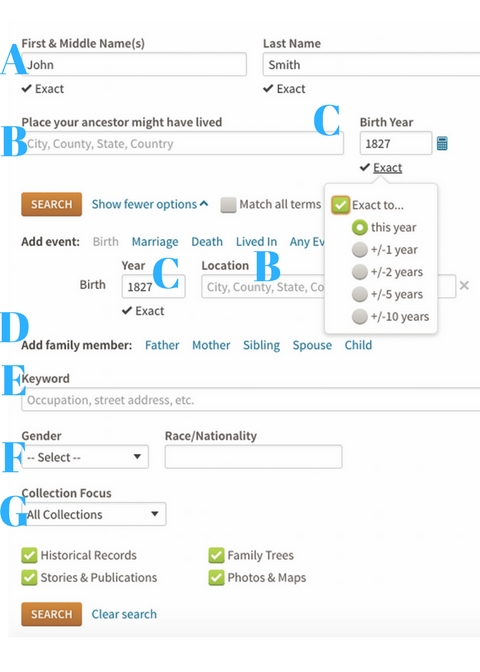
E (Keyword) F (Gender and Race/Nationality) G (Collection Focus)
When you kickoff log in to Beginnings.com, you'll encounter the search form. You also tin access this grade at whatsoever time hither or by clicking the Search tab on the navigation bar at the height of any page, then choosing All Collections from the dropdown menu.
If yous're lucky, a search on a name and birth twelvemonth volition immediately hitting the jackpot, with that antecedent's census tape or will start in the search results. But more than likely, the search will yield thousands of results requiring valuable time to slog through. You need to enter more information and permit for uncertain spellings and years of nascence and decease. To do that, click Prove more than Options most the bottom of the search form (you may already encounter these options, depending how y'all've used Beginnings.com in the by). Let's become through each part of the search form and discuss how best to use it in your search. As you lot follow along, log in to your Ancestry.com business relationship and try searches for someone in your family.
A. by Name
Enter your ancestor's start, eye (if you know it) and last names. You'll notice that when you enter a name in either field, the word "verbal" appears beneath with a checkbox. Click that discussion and several filter options pop up. These let yous specify how broad you want to search. No filters checked is the broadest search, which is a good starting indicate, or check ane or more of these filters:
- Verbal: Find only records with the names exactly as you typed them.
- Sounds Like: This uses various algorithms to observe records with names similar to what you typed.
- Similar: This option finds records with mutual variant spellings and alternating forms of the name you typed, including common nicknames for given names. It's besides a good idea to try separate searches with nicknames instead of given names, specially any unusual ones.
- Soundex (surname only): This finds surname variants that have the same Soundex system code as the one y'all typed (read well-nigh the organization at the National Archives).
- Initials (first/middle name only): This includes records that accept only starting time and/or middle initials matching the name you typed. The name fields let you search with wildcard characters to notice variants. The * represents null to five characters; the ? represents 1 character. Y'all tin can apply a wild card for the first or concluding letter, merely not both, and names must incorporate at least 3 non-wildcard messages.
If you have a family unit tree on Ancestry.com, the site may attempt to autofill the form with a person from your family tree. For example, when I starting time typing the name Calvin into the First and Centre Names box, Beginnings.com suggests Calvin Manlieus Dimmitt from my tree. If the suggested person isn't the person you lot want to find, ignore it and proceed typing the proper noun y'all need.
If the suggestion is the person you lot're searching for, click the name to autofill the search boxes with the person's name, nascence engagement and place, family members' names, etc. Y'all so can alter or remove the content in each field, depending what yous're looking for. If you desire a married woman's death record, for case, delete her maiden proper name from the search box. If y'all're searching for census records from her childhood, remove her married proper name, equally well as her spouse's and children's names from the family members area of the search grade (which we'll discuss in a bit).
Try running multiple searches with the names entered in different ways. For instance, if your ancestor'due south name was John Albert Johnson, you may have to type the name as John Johnson, John Albert Johnson, J. Johnson or J.A. Johnson. I've also seen people listed on censuses with the middle proper name commencement, or by only a middle name. As you do more searches, you'll become more than adept at spotting potential name anomalies.
Ancestry.com may render records that don't friction match the showtime name y'all typed in, but strongly match other criteria included in your search. If a result matches all criteria save the proper noun, it's worth taking a closer wait at the tape.
B. by Location
Our ancestors moved around more than we might realize, and their records may give different places of birth or refer to the aforementioned place with unlike names. And then it's helpful to allow for location variations when searching for people in records. One time you brainstorm typing a location proper name in Ancestry.com'south search form, the "place picker" volition serve upward suggested place names to aid you choose the location assigned in Beginnings.com'due south indexes. Choose a suggested place, or you won't get search results.
Like the proper name fields, filling location fields also brings up filters that allow you lot narrow your search. No filters checked is your broadest option: It'll return any records matching your other criteria, with those that as well match this place prioritized at the top of the list. Or y'all can cheque 1 of the filters to narrow your matches to records from
- exactly the place you entered
- exactly the county where the place is located the county where the identify is located plus surrounding counties
- the state where the place you entered is located
- the land and adjacent states
- the land where the place yous entered is located
Calculation a "Place your ancestor might have lived" helps focus your search. Yous as well tin can add places where other life events, such as birth or death, happened by clicking on that issue in the "Add event" area. Click Lived In to add some other place the person might've lived. Click More than to add a port of arrival or departure (if y'all're searching immigration records), or place of military service. If you click Whatever Event, your search will return records in which the person named has any life event occurring in the location you lot entered.
C. by Date
Adding a birth year to your Ancestry.com searches can help you distinguish among records of people who had like names and lived in nearby places. This is particularly helpful if your ancestor had a mutual proper noun, or if some other family of the same surname also lived in his community. Practise you know an ancestor's age, but not a nativity year? Click the figurer icon to figure out an ancestor's birth yr based on how old he was in a particular twelvemonth (such as during a U.s.a. demography).
You've probably noticed that our ancestors oftentimes were inconsistent about their ages and nascence dates in genealogical records. Many weren't overly concerned with keeping track of their ages. Some people didn't know their ain birthdays, particularly in the years before official birth records were kept. And, but as with names, whoever wrote down a person's birth engagement or age on a record might get it wrong. The search class's appointment fields offer filters to help yous notice records in which your ancestor'southward birth date is off past one, two, five or ten years in either management from the year you entered. You as well tin can search for records with exactly the yr y'all entered.
If you're searching for a relative's death records, click Death nether Add Effect, and enter the year of death. You tin add a engagement range, just as for a birth year. If you're searching for demography, marriage or other records—only non death records—information technology's best to get out this field blank. That'due south because most records about your ancestor were created while he was alive, and won't comprise anything in the decease field.
If you don't use any date ranges, your results will include records from all years, with the closest matches to other criteria ranked highest. To go more than-manageable results, it's important that you lot add a date for at least some life event, even if it'south only an educated guess.
D. by Family Member
This section of the search grade allows you to add the proper name of a family member who's likely to appear in documents such as censuses, passenger lists and vital records along with your relative. This could exist a parent, sibling, spouse or child. Click the relationship to add the person'due south name. When y'all enter a name, an Exact box appears below the field. If you check it, you lot'll run into only results in which that name appears in the record along with your target relative. If you don't check information technology, results containing the name yous enter will rank higher in your results.
Calculation a family member is peculiarly helpful when working with ancestors who have common names. Or if you're searching for an ancestor's wedlock tape, add the spouse to your search (use a woman'due south maiden name). Yous also can use this section of the search form to discover records of children born to a couple: Enter the names of an ancestral couple in the fields for Mother and Male parent, leaving the main first and concluding proper name fields blank. Try both a maiden and married name for the mother, as birth records might give the name either way.
E. past Keyword
The Keyword box is another way of filtering for better results. For example, if you know that you're seeking a person who served in the military during the Revolutionary War, enter revolutionary war. (It's not necessary to capitalize words in the search boxes.) Putting quotation marks effectually keywords ("revolutionary state of war") tells Ancestry.com that exact phrase must announced in records matching your search.
F. past Gender and Race/Nationality
These fields let you specify the gender and race or nationality associated with the person you're searching for. The latter field has an Exact checkbox. Information technology's usually best to leave these options blank, equally they're less important than other fields in narrowing your search. Using these fields may, in fact, filter out relevant records that didn't happen to specify these fields. That said, typing a full general race or nationality, such as German or black may help when you're searching for immigration or census records, in which these details might be recorded.
G. by Collection Focus
The last section of the search class lets you target your search more precisely by narrowing results to sure collections. As Beginnings.com increases its international content, this is a handy manner to view only records related to your ancestors' places. A dropdown carte lets y'all select a particular place or an ethnicity (blackness, Jewish or Native American—groups for which records often cantankerous national boundaries). I encourage yous to use this option if you lot know where a person lived. For example, if an antecedent lived his entire life in Canada, select Canada every bit the collection focus to render only records that are identified as Canadian records. Optionally, y'all tin choose All Collections. If your ancestor lived in multiple places (such as commencement in the United kingdom of great britain and northern ireland, then Canada, and then the United States), try doing multiple searches, each with a dissimilar collection focus.
At the lesser of the search course, you'll see checkboxes by 4 collection types:
- Historical Records: censuses, passenger lists, draft registrations and other records
- Stories & Publications: newspapers, published family histories and stories fastened to public family trees
- Family unit Trees: profiles in family trees other Beginnings.com members have posted (if the tree is private, you tin message the person through Ancestry.com)
- Photos & Maps: images (not necessarily only photographs) attached to family trees, too as gazetteers and maps
Check the box side by side to each blazon of record you want searched. You lot might want to see just documents, for case, or y'all might be hoping for a photo of your dandy-gramps. If you're simply starting your search, go out all the boxes checked to get as many results as possible, so refine your search to eliminate what yous don't find helpful.
Refining Your Search Results
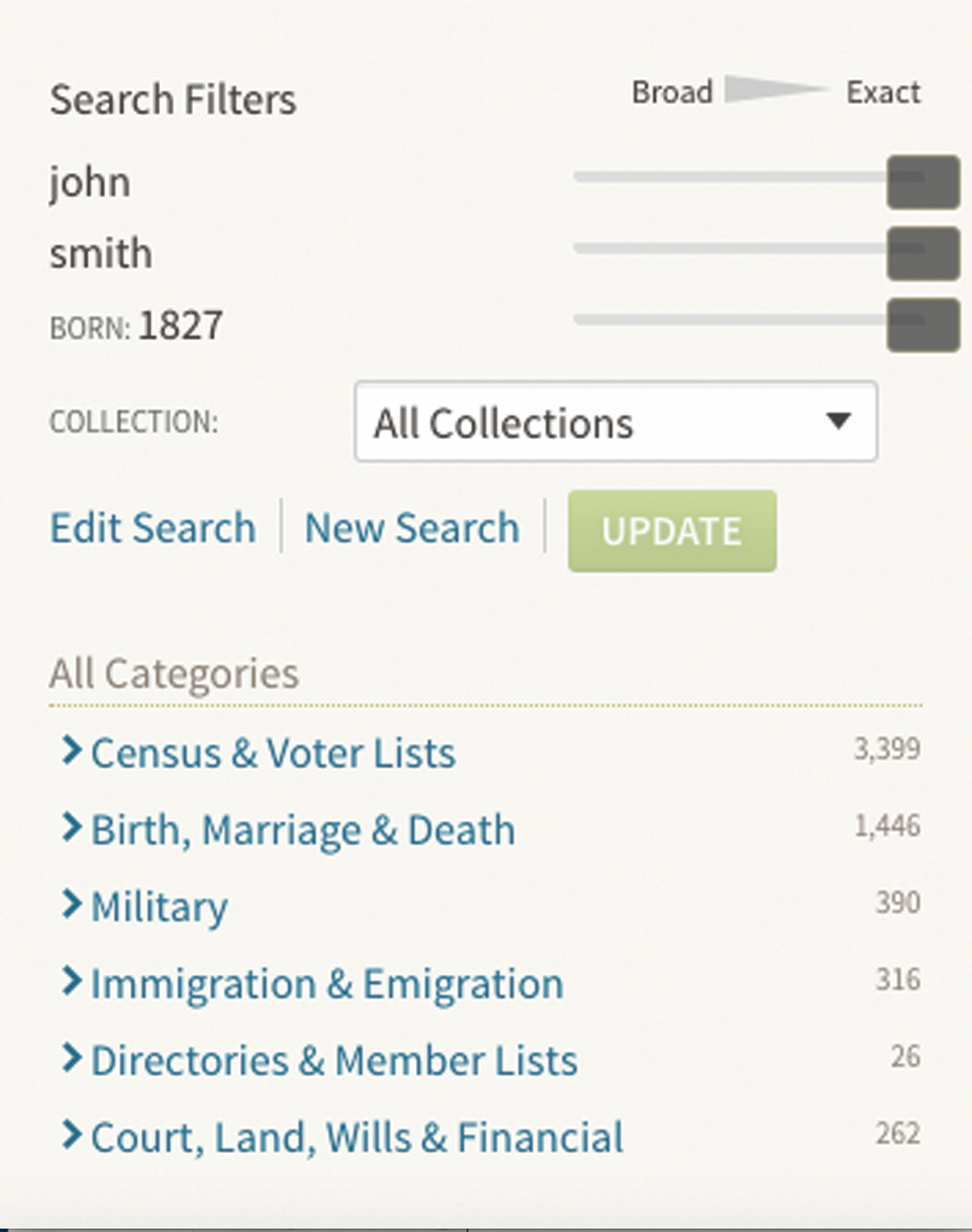
After you've looked through a few search results, y'all might desire to endeavor a name variant, augment the nascence year range or make some other aligning. You can exercise this without returning to the search course by using the tools at the top left:
H. Sliders
The sliders (located under the Search Filters heading) let yous chop-chop broaden or narrow search fields including first and final name, places of life events, and engagement ranges of life events. Slide right to narrow, left to broaden. When you hover over each position on the slider, a popular-up will show you the settings for the position. Click Update to utilise the new filters to your search results. When I search for my granddaddy Herschel Hendrickson, born in 1888 and living in Missouri, I get more than 86,000 results when all sliders are on the broadest setting. If I move the proper name and birth year filters to the right, I narrow this to just four results—and all are for Grandad.
To change your search terms and add together new ones, click on Edit Search. The search form opens with your current terms; make any changes and click Search to see your new results. To start over with a cleared form, click New Search.
I. Category Filters
Another way of filtering is to confine results to specific categories (as well called collections). To the left of your search results, underneath the sliders and the All Categories heading, you'll see filters for categories of records. Find a category that interests yous and click on information technology. Your search results change to bear witness only records in that category. The filter listing changes to testify whatever subcategories, which you also tin click on to further narrow your results—correct downwards to the titles of specific collections.
Keep in listen that if y'all utilise a category filter and then Click Edit Search, the search form options you come across volition be specific to the category you've applied. Immigration records, for example, generally don't name relationships among those in the records, so the search class for the Immigration and Emigration category doesn't have fields for calculation family members.
A version of this article appeared in the March/April 2018 issue of Family Tree Mag.
Related Reads

Searching on genealogy mega-site Ancestry.com can experience overwhelming. Here are tips and other free resource to help you become the nigh out of your Ancestry searches.

Non sure where to start on Ancestry.com? Follow these enquiry tips and tricks to get on the right rail.
Go Your Free Essential Genealogy Enquiry Forms
Sign up for the Family unit Tree Newsletter and receive ten inquiry forms every bit a special thank you!
Get Your Free Genealogy Forms
barnhartfashe1978.blogspot.com
Source: https://www.familytreemagazine.com/websites/ancestry-help/master-ancestrys-search-options/
0 Response to "How to Search Sources in a Family Tree in Ancestry"
Post a Comment